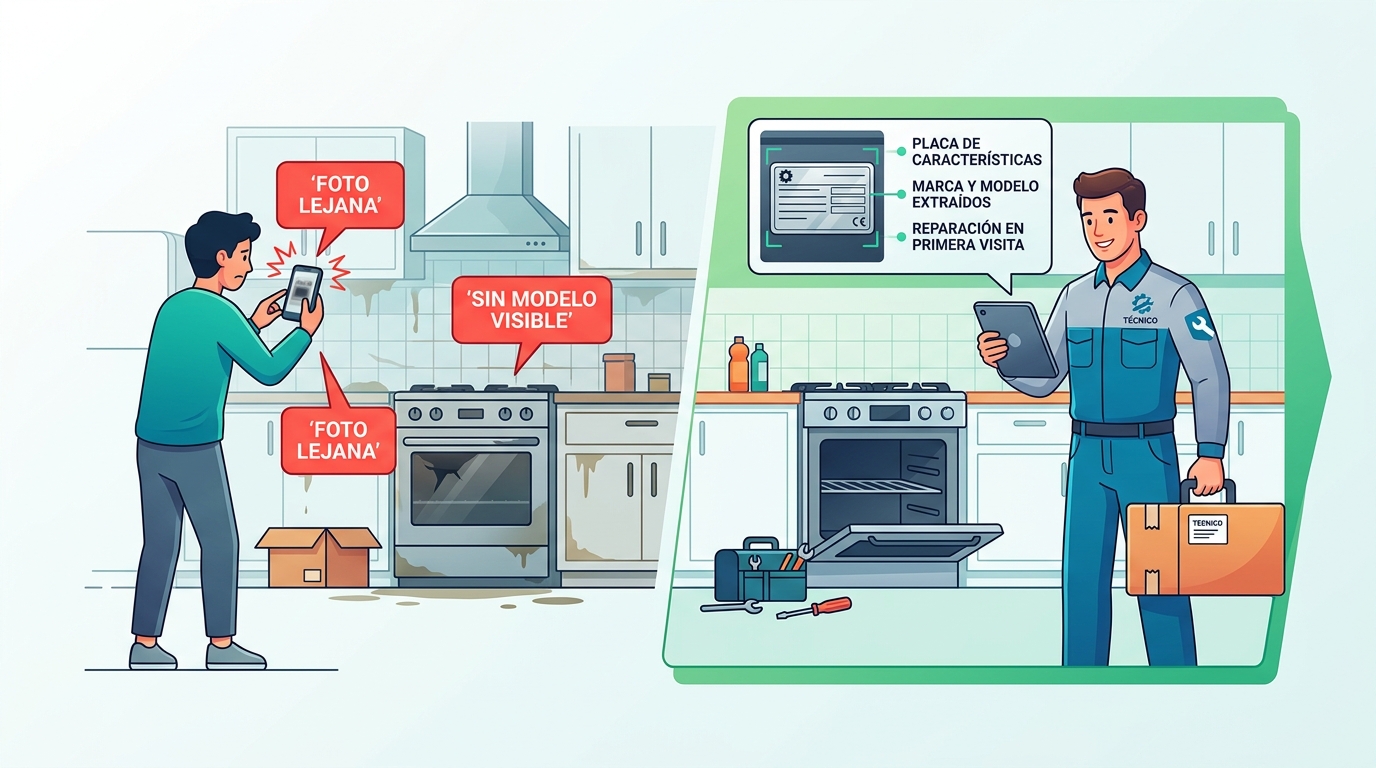
On Wednesday morning, Jorge, a property manager in Valencia overseeing 75 rental units, received a WhatsApp message from a tenant in apartment 3B: "The built-in oven tripped the electrics and will not heat up." Attached was a dark, wide-angle photograph taken from three meters away showing the kitchen cabinets. Jorge called his appliance repair contractor, who immediately asked: "Is it a Balay 3HB series or a Bosch? What is the full alphanumeric code printed on the door frame sticker?" Jorge had no idea. He messaged the tenant, who was at work and only replied at 19:00 with: "It is a silver Balay." The technician arrived on Friday morning, opened the oven door, inspected the metal rating plate, and delivered the predictable verdict: "This specific model uses a 2100W circular heating element that I do not carry in the van. I will have to order it from the warehouse and return next Tuesday." The visit resulted in an €85 call-out fee simply to read a serial sticker, leaving the tenant without a cooker for six days and sticking the property owner with two separate call-out charges for a fifteen-minute repair.
The hidden tax of the discovery visit
In property maintenance communities, experienced managers know this recurring headache as the "discovery fee" problem. An appliance repair contractor cannot carry replacement parts for four thousand different white-goods models in a single van. When a technician is dispatched based on a vague description like "the washing machine does not drain" or "a silver oven," their first visit is almost guaranteed to be purely diagnostic.
Every managing agent knows that dispatching an appliance technician based on a wide-angle photo routinely leads to paid discovery visits and days of waiting for parts, while forward-thinking agencies capture the manufacturer rating plate at intake, allowing contractors to arrive with the exact replacement part on visit number one. Left to their own devices in casual chat channels, tenants naturally take context photos of the entire appliance rather than the technical data badge hidden on the door frame or behind the kickplate.
The operational cost of missing serial data
When an agency operates without technical intake standards, administrative staff spend hours playing telephone between tenants and repair companies. The agent sends three follow-up messages asking for a clearer photo, the tenant cannot find the sticker, and the technician refuses to book a slot until the exact brand is confirmed.
Furthermore, without model verification, agencies lose the ability to perform basic asset management. Property managers cannot check whether an oven is still under manufacturer warranty, nor can they verify whether the broken appliance actually belongs to the landlord's official inventory before dispatching a contractor. The result is compounding friction: irritated tenants eating takeaway food, frustrated technicians wasting fuel, and suspicious landlords questioning maintenance invoices.
| Casual WhatsApp Intake | Automated Rating Plate Extraction |
|---|---|
| Wide-angle photo of the oven door from 3 meters. | Close-up photo of the rating plate prompted automatically. |
| Technician arrives blind; needs a 2nd visit to bring parts. | Technician arrives on visit #1 with the exact component. |
| Landlord pays an €85 discovery fee to read a sticker. | Zero discovery fees; single-visit first-time fix. |
| Tenant waits 6 days without an essential appliance. | Downtime cut in half; repair executed in 48 hours. |
How leading agencies achieve first-time fixes
Progressive rental agencies do not treat appliance breakdowns as general customer service inquiries; they treat them as precision technical tickets. They have established automated workflows that guide renters to capture necessary diagnostic data from the very first interaction.
All of us know that playing detective over chat to figure out whether a boiler is a Cointra or a Junkers drains valuable staff energy, while modern agencies use automated triage to prompt tenants for a photograph of the technical rating plate whenever an appliance, boiler, or air conditioner issue is selected. The system uses AI vision to extract the brand, model number, and error code directly from the image, placing clean technical specifications into the agent's dashboard. The property manager can cross-check the model against the lease inventory in five seconds and hand the contractor the exact part specification on the first call.
Final reflection
Your property management firm should never waste owner funds paying contractors to act as high-priced sticker readers. Tools like TenantDesk automate maintenance intake via WhatsApp and Telegram, prompting tenants for close-up rating plate photographs and using vision intelligence to extract appliance models and error codes before routing the ticket to Chatwoot. By capturing precise technical data at step one, you eliminate paid discovery visits, delight your repair partners, and resolve appliance breakdowns on the very first trip.