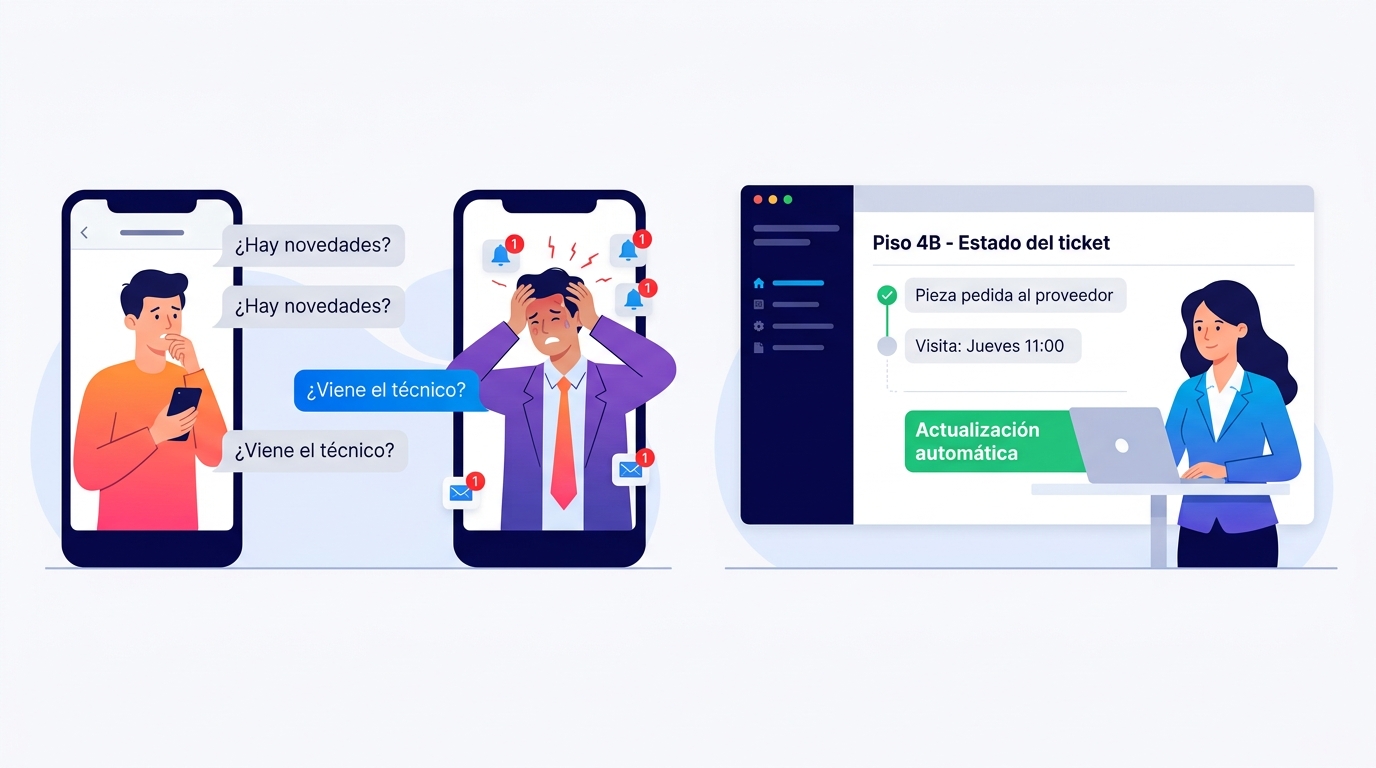
On Tuesday at 11:30, Lucas, a property manager overseeing 85 rental units in Zaragoza, called his appliance contractor to order a replacement thermostat for an oven in apartment 4B. The technician confirmed that the component was ordered and would be installed on Thursday afternoon. Lucas felt confident: the repair was fully on track. However, between Tuesday afternoon and Wednesday evening, Lucas received six separate WhatsApp messages from the tenant: "Hi Lucas, any news on the oven?", "Has the technician replied yet?", "Can you tell me what time they will arrive?", "We cannot cook dinner, please give us an update." Lucas spent nearly half an hour stopping his core tasks, typing polite reassurances, and explaining logistics completely out of his control. Multiplied across twelve active maintenance cases in the portfolio, Lucas's team was losing nearly three hours every day simply answering the exact same question: "Any updates?"
The anxiety of the operational black box
In property management, the most frequent tenant communications are rarely new fault reports; they are anxious inquiries about existing ones. When a resident submits a maintenance ticket and hears nothing for twenty-four hours, they naturally assume their request has been forgotten in a drawer. The absence of communication creates a psychological vacuum that renters immediately fill with frustration and impatience.
Every managing agent knows that silence between the initial report and the contractor's arrival triggers relentless follow-up messages from anxious tenants, while forward-thinking agencies automate milestone updates, reducing repetitive status queries by up to 80%. When an agency operates through manual chat messaging, agents become emotional air traffic controllers, spending their mornings reassuring tenants rather than resolving actual property issues.
The compounding cost of manual reassurance
Typing a quick text saying "we are waiting on the parts supplier" seems harmless when considered as an isolated task. But context switching is a well-documented killer of administrative productivity. Every time a property manager stops drafting a lease or reviewing property accounts to reassure a tenant, it takes up to fifteen minutes to regain deep focus.
Moreover, manual status updates are inherently inconsistent. When an agency handles forty active maintenance tickets across multiple staff phones, updates only get sent when a tenant complains loudly enough. Squeaky-wheel tenants receive constant attention, while patient residents are left in total darkness, breeding quiet resentment that later manifests as negative online reviews or lease non-renewals.
| The Manual Reassurance Cycle | Automated Status Transparency |
|---|---|
| Tenant texts every 4 hours: "¿Hay novedades?". | Tenant receives automatic milestone notifications. |
| Agent wastes 25 minutes per case typing explanations. | Self-service "Check Status" button inside the chat. |
| Constant context switching breaks daily focus. | Zero manual reassurance typing required from staff. |
| Anxious tenants feel ignored and complain publicly. | Tenants feel informed, respected, and in control. |
How top agencies eliminate follow-up chaos
Modern property agencies have recognized that communication volume is an operational defect, not a virtue. They have replaced reactive manual messaging with transparent, automated milestone triggers.
All of us know that spending hours updating tenants on supplier delays burns immense cognitive energy, while agencies using automated triage provide real-time status tracking directly inside WhatsApp. When an agent changes a ticket status in the back-end (e.g. from "Diagnosed" to "Parts Ordered" or "Appointment Scheduled"), the system sends a clean, automated notification to the tenant instantly. Furthermore, tenants can type a simple command like "status" at any time to see the exact progress of their ticket. The anxiety vanishes, and the phone stops ringing.
Final reflection
Your team should not spend their working lives serving as human status monitors. Tools like TenantDesk automate maintenance intake and ticket progression via WhatsApp and Telegram, providing clear milestone notifications and self-service status lookups from the moment an issue is logged. By replacing manual reassurance ping-pong with structured transparency, you protect your agency's productive hours, eliminate tenant anxiety, and deliver a calm, modern service experience.