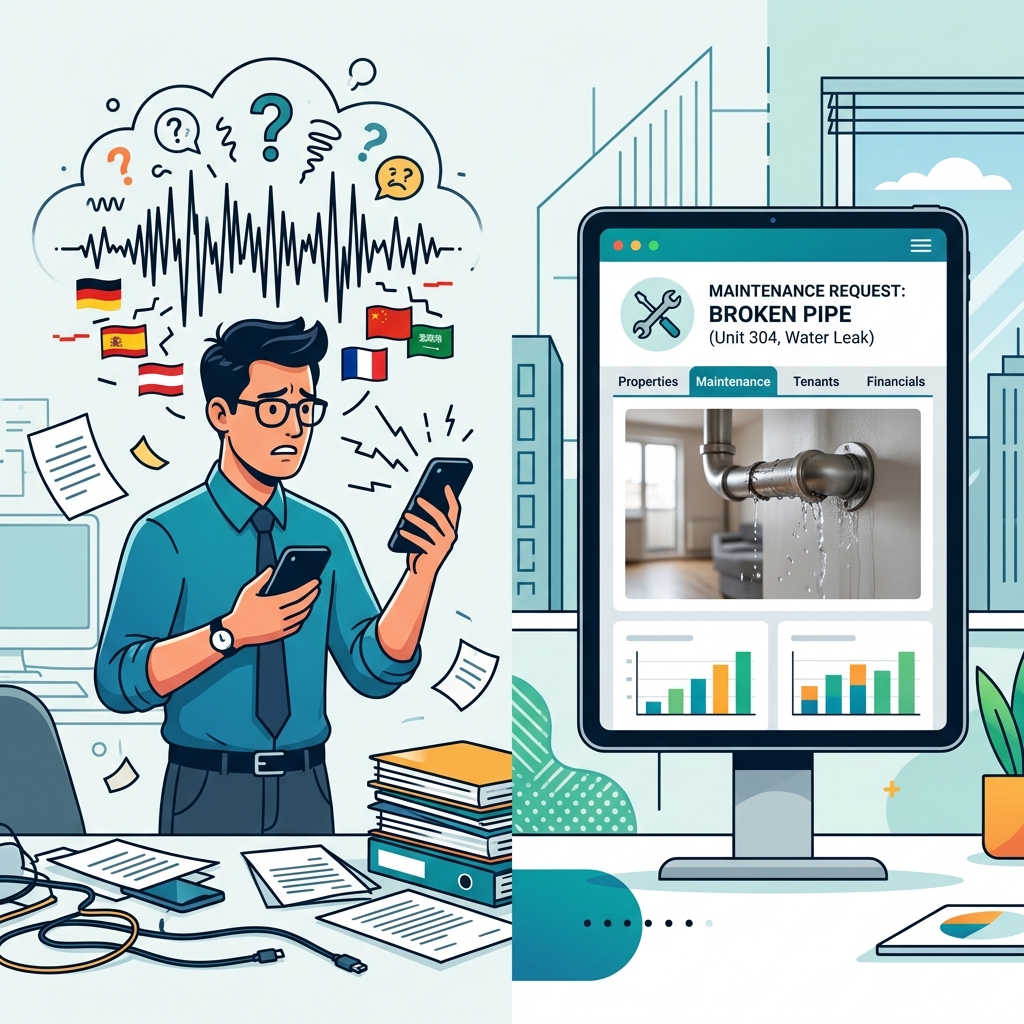
David, a property manager in a busy coastal city, opened a WhatsApp voice note from a new international tenant on Monday morning. What followed was two minutes of background noise, a strong foreign accent, and fragmented vocabulary that made it completely impossible to understand what exactly had broken in the flat. After listening to the audio three times, David had to spend the next twenty minutes sending messages, copying and pasting text into a translation app, only to discover that a window hinge was stuck. A problem that should have taken thirty seconds to classify had derailed half an hour of his morning.
The Hidden Cost of International Portfolios
As cities globalise, rental agencies are managing an increasing volume of expatriates, digital nomads, and international students. While this demographic represents a highly lucrative market, it introduces a significant operational friction point: the language barrier. When incident management relies on unstructured phone calls or chaotic voice messages, different accents and limited vocabulary turn the simple reporting of a maintenance issue into an administrative nightmare.
We all know that trying to decipher a complex plumbing problem through a translation app is incredibly inefficient, while the most profitable agencies understand that standardising the onboarding process completely eliminates the language variable. The friction does not end with the initial message; every subsequent communication - coordinating the technician's visit, explaining the repair, confirming the schedule - requires manual translation, tripling the time a manager spends on a single incident.
The Danger of Deferred Maintenance
Our operational audits reveal a far more dangerous consequence of this language barrier: silent deterioration. Tenants who struggle with the local language often avoid reporting minor issues simply because the idea of explaining a small leak over the phone, or discussing a repair in a foreign language, feels too daunting. They prefer to ignore the dripping pipe until the ceiling of the flat below collapses.
This reluctance to communicate creates a backlog of deferred maintenance that ultimately devastates the landlord's budget. When an agency relies on conversational messaging as its primary method of receiving notices, it inadvertently discourages international tenants from reporting the early warning signs of serious structural damage.
Case Study: A property management company managing 150 homes in a popular expatriate destination noticed a spike in claims for serious water damage. Analysis showed that international tenants delayed reporting small leaks by an average of three weeks due to language anxiety. By implementing a digital and visual reporting funnel, based on photographs, that eliminated the need for complex descriptions, the agency recorded a 40% increase in early maintenance reports, saving its landlords thousands of euros in urgent structural repairs.
Avoiding the Translation Trap
The industry instinct is often to hire bilingual staff, but throwing costly human resources at a data entry problem is a strategy that does not scale. One property manager cannot be expected to master five different languages just to dispatch a plumber. The solution is not to translate better; the solution is to eliminate the need for conversation in the first place.
Leading firms have completely eliminated the "expatriate bottleneck" by enforcing a visual triage process. When a tenant has a problem, they do not leave an incomprehensible voice note. Instead, they are required to send a clear photograph of the issue along with categorised data points that are universally understood (for example, location, type of appliance, level of urgency). A photo of a broken radiator valve does not require translation.
Final Reflection
Allowing language barriers to dictate the speed and accuracy of your maintenance operations is an unnecessary drain on your team's resources. Managing international tenants should increase your revenue, not your administrative stress. Tools like TenantDesk automate the reception of maintenance reports via WhatsApp and Telegram, enforcing the collection of structured and photographic data before a single word needs to be translated. To protect both your team's time and your landlords' assets, you must stop relying on confusing verbal descriptions and start demanding universal visual evidence.